

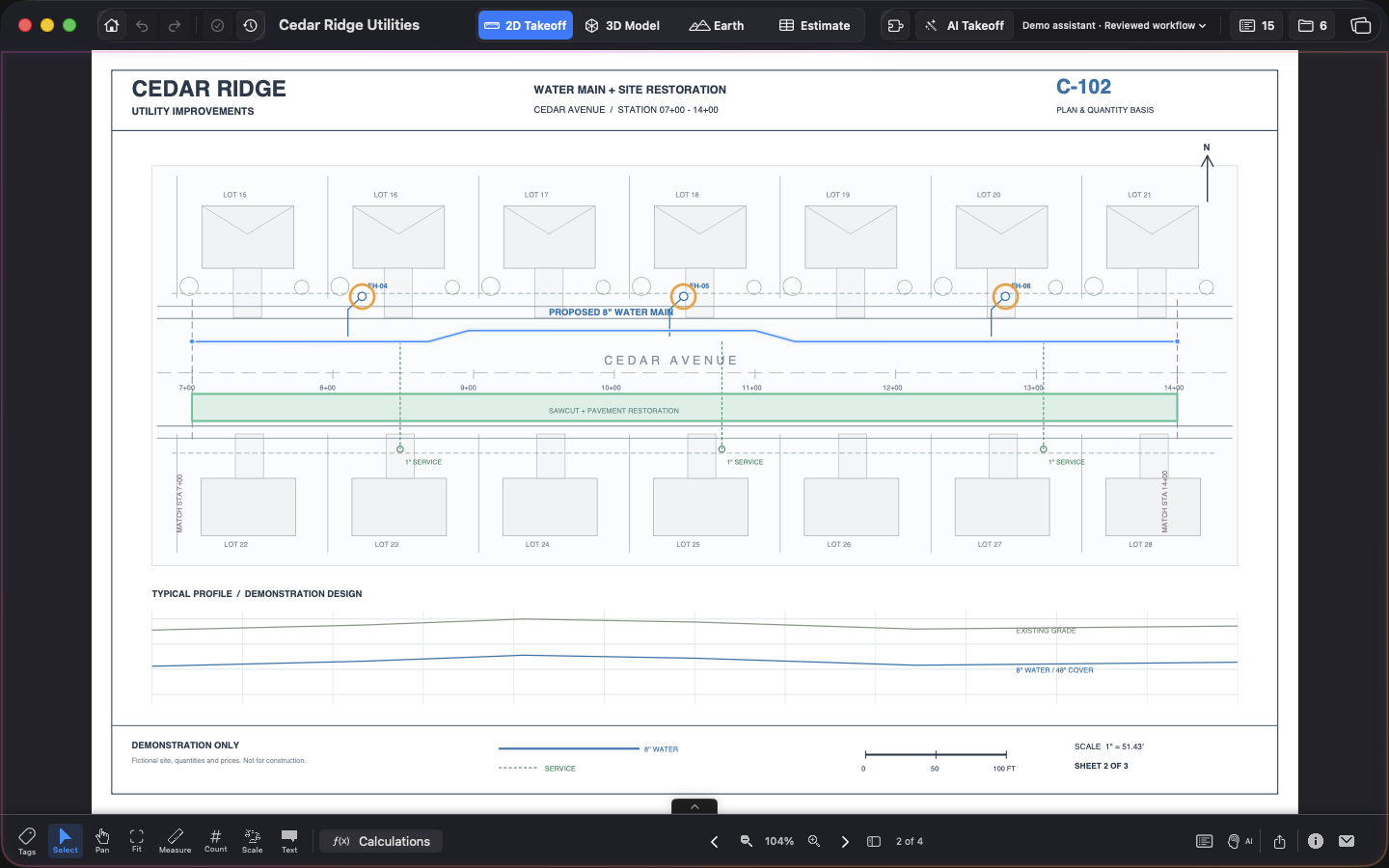
The scope on one project
Pipe, fittings, and the surface you restore.
Utility takeoff goes wrong when the run lives on three sheets and the restoration lives in someone's head. takeoff.bid keeps the measured scope together:
- Water, sewer, and storm runs in linear feet.
- Hydrants, valves, and similar appurtenances by count.
- Pavement restoration and other areas in square feet.
The Cedar Ridge sample shows 2,106.36 LF of water main, 9 hydrants, and 40,500 SF of pavement restoration. The illustrative owner schedule uses 2,100 LF for the main. Those figures are not a client's bid. They exist so you can see how mixed units stay on one project.
Across the join
Follow the main across a roll plot.
Water and sewer plans rarely fit on one sheet. On Mac, Construction Takeoff can stitch adjoining sheets into a roll plot. Review the alignment at each join, then follow the takeoff across the combined run instead of hopping C-01 to C-02 to C-03 and hoping the stationing still matches.
That workflow is in the Mac app today. The browser version is a separate early-access release for PDF takeoffs and AI review; use Construction Takeoff when you need the joined view. See the Mac takeoff app.
After the takeoff
Price the same run. Check it against the owner schedule.
A utility estimate is more than LF times a unit price. Production turns 2,106.36 LF into workdays (10.53 days at 200 LF/day in the sample, 8.43 at 250 LF/day). Those are example calculations, not a production claim. On Mac you can sit the crew, the duration, and the bid next to the measured pipe.
Then compare the owner quantity with the measured takeoff. If the schedule is 2,100 LF and the plan measures 2,106.36 LF, you want that difference on purpose, with the geometry still attached. That is the takeoff-to-estimate-to-bid loop applied to a linear job.
AI on a utility set
Let it trace the run. You still walk the sheet.
Pipe takeoff is repetitive enough that a compatible assistant can help inspect linework and propose measurements. It is also easy to miss a fitting, a hydrant, or a sheet match line. Review stays with you: scale first, then the run, then the count.
Mason built this after about 10 years in construction and 5 years estimating and project managing, including the kind of water and restoration work this sample is modeled on. Estimating software stalled after the first digital takeoff tools. The useful step now is automated counting that an estimator can still refuse.
How automated takeoff is reviewed · AI estimating, estimator in charge
Questions estimators ask
A few useful details
Can I take off a water main that spans several sheets?
Yes. On Mac, stitch adjoining sheets into a roll plot, check the joins, and follow the run across the combined plan. The browser takeoff still works sheet by sheet.
What units does a utility takeoff usually need?
Pipe in linear feet, restoration in square feet, and fittings or hydrants by count. takeoff.bid keeps those units on the same project so the estimate can price them together.
Is Cedar Ridge a real job?
No. Cedar Ridge Utilities is an original fictional sample with three utility sheets and an owner bid schedule. Quantities, rates, and production assumptions are illustrative.
Can AI help with pipe takeoff?
A compatible assistant can inspect linework and propose measurements. You review the scale, the run, and the result before those lengths become a quantity you would price.